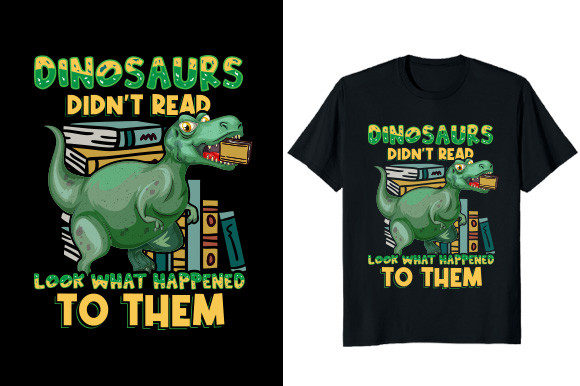
Dinosaurs Didn t Read Look What Happened
I have spent years reviewing digital assets for my own embroidery business, and I know that a clever concept is only half the battle. The other half is execution: how does it actually hold up under the needle? Today, I am evaluating Dinosaurs Didn t Read Look What Happened, a design that has caught my eye for its witty premise. It is categorized under T-Shirt Designs and Graphics, but as an experienced designer, I need to look past the label and see if this file translates well into a tangible, high-quality finished product.
The first impression of Dinosaurs Didn t Read Look What Happened is one of playful irony. The text suggests a narrative that is both humorous and slightly educational, which is a powerful combination for a handmade product. When I first laid eyes on the layout, the visual personality felt bold and confident. It isn't trying to be delicate or overly intricate; instead, it leans into a statement piece aesthetic. This mood makes it naturally suited for casual wear, home decor, and gift items where humor is the primary draw. For a crafter looking to create a unique item for a craft fair or an Etsy shop, this design offers immediate conversation value.
Let me take you through a real-life scenario I recently considered with this design. I was preparing a custom embroidered tote bag for a local library fundraiser, specifically targeting teachers and parents who love history. I immediately thought of Dinosaurs Didn t Read Look What Happened. The idea of a dinosaur learning a lesson about reading, paired with the consequence, fits perfectly with a literary theme. However, moving from screen to fabric requires careful planning. If I were to stitch this onto a canvas tote, the thread colors would need to pop against the natural or dark weave of the bag. The design's clarity is vital here; if the lettering gets lost in the texture of the fabric, the joke falls flat.
In terms of performance across various projects, Dinosaurs Didn t Read Look What Happened shows promise for several categories. On custom apparel like sweatshirts and t-shirts, the design works best when placed centrally or on the back of a garment. The phrase is long enough to command attention but not so dense that it becomes a chore to stitch. For baby embroidery, such as on a onesie or a small bib, the humor is relatable for parents, making it a strong candidate for personalized gifts. The design also translates well to holiday embroidery, serving as a fun stocking stuffer or a unique addition to a family matching set.
However, practical judgment dictates that we must discuss where this design should be used carefully. Small hoop sizes present a significant challenge. If the lettering is compressed too much, the satin stitch may become too narrow, leading to thread breaks or a lack of definition. Textured fabrics, such as heavy fleece or bouclé, can hide the details of the design, making the text harder to read. Thin or stretchy fabrics require a robust stabilizer strategy; without proper support, the tension of the stitches could pucker the material, ruining the drape of the garment. Furthermore, on curved surfaces like caps, the perspective distortion can make the message difficult to decipher unless the digitizing accounts for the curvature.
Another area to scrutinize is the density of the stitch work. Dense fill areas are prone to bird nesting or thread bunching if the machine settings are not calibrated correctly. For a commercial embroidery project intended for mass production, consistency is key. If every unit comes out with slight variations in thread coverage, customer trust in the brand will erode quickly. The design needs to maintain its visual appeal even after multiple washes. If the edges fray or the colors bleed, the perceived value of the handmade product drops significantly. Therefore, testing the design on scrap fabric before committing to a final run is non-negotiable.
When considering the visual impact on the final product, Dinosaurs Didn t Read Look What Happened adds a layer of personality that generic designs often lack. A well-executed embroidery project elevates a simple item into something special. For an Etsy seller, this means higher engagement and better reviews. Customers appreciate designs that tell a story or make them smile. The professionalism of the finished piece relies heavily on the quality of the digital embroidery file itself. If the vector paths are clean and the stitch types are appropriate—using running stitches for outlines and fill stitches for blocks—the result will look polished. Conversely, poor digitizing can turn a great concept into a messy blob of thread.
For those of us in the craft business, understanding the file formats provided is crucial. The product description mentions EPS, SVG, JPG, and mockup files. As an embroiderer, the SVG and EPS files are your most valuable assets for resizing and adjusting the design to fit different hoop sizes. Before starting any project, I always recommend checking the stitch density and confirming whether the design includes necessary underlay stitches. These technical details ensure that the thread sits flat and covers the fabric evenly. If you are using this for applique design, you will need to verify if the separate pieces are included or if you need to digitize them yourself.
Licensing is another critical factor for anyone planning to sell finished items. The description states the design is for POD business or personal use, but it is essential to confirm the specific terms regarding commercial sales. Are you allowed to sell unlimited quantities? Do you need to attribute the creator? Failing to check these details can lead to legal issues down the line. Always review the license agreement thoroughly before incorporating Dinosaurs Didn t Read Look What Happened into your inventory.
To ensure success with this design, follow these practical steps. First, test the design on scrap fabric using the same thread colors and stabilizer you plan to use for the final project. This helps you gauge the contrast and stitch density. Second, inspect small details closely. If there are tiny curves or sharp angles, ensure they will stitch cleanly without breaking threads. Third, compare light and dark fabric backgrounds to see how the thread colors perform in different lighting conditions. Finally, use a printable mockup to visualize the design on the actual product before stitching, saving you time and materials.
In conclusion, Dinosaurs Didn t Read Look What Happened is a versatile and engaging design that can add a touch of humor and creativity to a wide range of embroidery projects. From tote bags and aprons to nursery decor and boutique branding, its potential is vast. However, the difference between a mediocre product and a standout item lies in the preparation and execution. By paying attention to fabric choice, stabilizer usage, and stitch quality, designers and small business owners can transform this digital asset into a beloved physical object. Whether you are a hobbyist creating a gift or an entrepreneur building a brand, this design offers a solid foundation for a successful embroidery project.